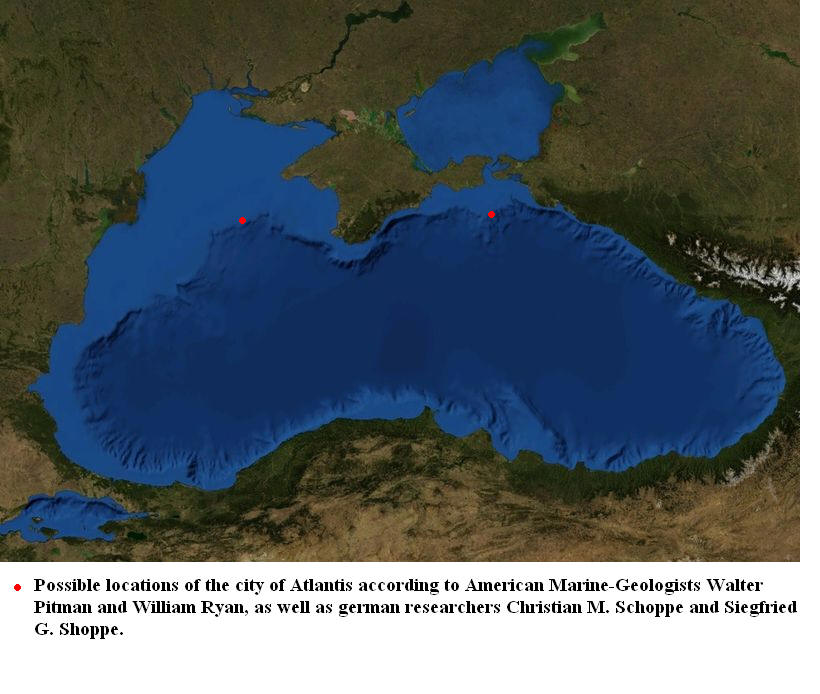
THE BLACK SEA ATLANTIS CIVILIZATION
There have been many legends about an ancient civilization that sank beneath the
sea. The most famous ancient writer who spoke of such a civilization was the
Greek Philosopher, Plato. In his dialogues, Critias and the Timaeus, he claimed
that a Greek traveler by the name of Solon, learned of a civilization by the
name of Atlantis. Atlantis was supposed to had sunk beneath the waves nine
thousand years earlier and was located “beyond the Pillars of Hercules.”
The world of Plato, 335 B.C., was filled with legends of civilizations destroyed
by a terrible natural catastrophe. The truth is, when Plato wrote his account of
Atlantis, he was actually drawing on many sources, and tried to give a complete
account of the Atlantis legend by combining bits and pieces of different tales
into his legend. He probably confused many of the facts, and thus, there is both
truth and misconception in his account.
Plato claimed Atlantis it was “beyond the Pillars of Hercules,” and the Straits
of Gibraltar has been referred to as the Pillars of Hercules, thus, Atlantis was
located in the Atlantic Ocean, but the Pillars of Hercules was a term of a
geographical expression, like “island,” “peninsula,” or “mountain.” It was the
name for all geographical landmarks that included a channel of water passing
through two land points possessing some kind of tall mountain or hill, that
included the Straits of Messina, between Sicily and Italy, the water way between
Attica and Argolis in Greece, and the Dardanelles and the Bosporus. Most straits
in the Mediterranean Sea were referred to as the Pillars of Hercules. So
Atlantis could have been located beyond Attica or beyond Sicily or beyond the
Bosporus, just as much as it could have been located beyond Gibraltar.
The original name for Atlantis was probably Thule, but the Greek philosopher,
Plato, Hellenized the name of this lost civilization, because he was writing for
a Greek audience. We have to remember that pagans made a point of changing names
of Gods, and their homelands, into their own language, using the names of their
own Gods and religious terminology to explain stories and tales of other people.
To them, it was not the literal truth that was important, but the essence of the
meaning behind the tale. Plato and other Greek writers saw nothing wrong in
explaining the legend of Thule with Greek names, Gods and geographical
expressions.
The Atlanteans that Plato writes about was actually the original Aryan
civilization that once existed along the shores of the Black Sea. Their
civilization had existed nine thousand years before his time. He speaks of their
accomplishments, expansion and destruction, but we must remember that Plato was
relying on sources passed down through millenniums and combined with other
legends.
Plato described for us a great civilization in possession of technology and a
source of energy that is beyond anything that existed in his time, or in our
own. The Atlanteans had harnessed this power and used it to transform themselves
and the world around them. They had become masters of their environment,
creating great cities, building devices in which they could travel far beyond
their homeland. This technology was the science of the Vril, and it was given to
them by the Gods.
The original language spoken by the Atlanteans was the mother tongue of all
Indo-European languages, and was intimately linked to the Vril. They used
language as an instrument to assist them in agriculture, by causing plants to
grow, tame wild animals, bring about medical manifestations by healing the sick,
as well unleashing terrible forces of destruction. Their mental and spiritual
abilities were far beyond those in which we possess today, and made them seem
like Gods to those humans that existed in the world at the time. By mastering
the power of the Vril, they had advanced their evolutionary development,
altering their DNA, and transformed themselves into semi-divine God-men. In
their travels, they assisted other humans in establishing civilizations,
instructing them in law and religion, and bestowing on them, their science and
techniques in tool-crafting, architecture and agriculture. Other humans
venerated them as Gods, or as a race of God-men who they looked to for advice
and guidance, and unquestioningly obeyed their commandments.
The Atlantean scientists discovered that genetics was the secret to obtaining
the Vril as a source to power, and established both a religion and science,
based on this fact, and thus, were able to master the use of the Vril. This
permitted them to speed up their evolutionary process, gradually transformed
themselves into a new race through carefully cultivating mutations within
themselves. Thus, they rapidly transformed themselves into a new species that
caused them to stand out in great contrast to the rest of humanity that existed
at the time. This is true not just in the level of the technology of their
civilization, but in their appearance, making them seem like a race of giants or
God-men to the other humans living at the time.
Besides appearing both beautiful and radiant, their race possessed an average
height between six and seven 7 feet tall, with perfectly developed features and
bodies that made them appear super-human to other humans. But their minds were
also transformed, possessing the ability to pass on their memories to the next
generation, in a form of blood memory, or what science calls, racial memories.
People could recall the events and achievements of their ancestors with a
clarity of remembering things within their own lifetimes. Their minds also could
photographically recall everything they saw, read or heard, and we have accounts
of people throughout history remembering thousands of lines of text verbally.
The Greeks, druids and others never wrote down their legends and tales and could
recite thousands and even tens of thousands of lines of verse orally.
Since the source of their power was the Vril, it was an endless and clean
reservoir of energy. This means that their buildings and structures were not the
grandiose, but designed in a environmentally pleasing style. Their cities and
communities were modestly designed, richly decorated, possessing the most modern
devices and harmoniously blend in with their natural environment. They did not
have to rip up the landscape to build roads, railroads or airports since their
transportation crafts were powered by the Vril, and thus, utilized a form
anti-gravity power, being able to left vertically and fly effortless at great
speeds, in all directions, including over the sea and to the deepest depths of
the ocean, and even leave the atmosphere of this planet and travel through
space.
Though they were venerated by other humans, they refrained from inflicting
themselves on them, nor did they try to impose their ways on them, at least for
most of their history. It was only later in the history of their civilization
that they dared to think of themselves capable of interfering in the evolution
of other peoples. And these primitives, witnessing the special powers they
possessed, were all too readily to accept their guidance and bow down before
their commandments without question. They tried to educate them in the ways of
their science, law, religion and the arts, teaching them the rudimentary
foundations of civilization. But in time, these other humans discovered that
they were not Gods, but human like them, and soon their admiration turned to
contempt and eventually, jealousy and hate.
THE ANCIENT ARYANS–THE TRUE ATLANTEANS
Around 12,000 to 10,000 B.C., the region extending from western Europe to
central Asia was inhabited by the first modern humans. Humanity had already
divided into the different races that we recognize today. And these humans
belonged to what we would refer to today, as the White, or Caucasian Race. They
also have been referred to as the Ur-people. “Ur” is another name for the Vril.
But around this time, a small group of them living along the shores of the Black
Sea, were taught the use of Vril Science by the Gods. About 50,000 and 40,000
years ago, the Gods of our ancestors–that unique pantheon of Gods who mixed with
our distant ancestors, when they were still proto-humans, mixed their Life Force
with theirs and thus, caused evolution to speed up and created our distinct race
of humans. These same Gods once again spoke to our ancestors, and a small group
of them, living around the shore of the Black Sea, heard their call. The Gods
walked among them and educated them. The Greek, Hesiod wrote that, “At the time
of the Golden Age, the Gods clothed in air moved among men.” They came to
Midgard and taught the Aryans the secret of the Runes. With this secret
knowledge, the Aryans were able to harness the power of the Vril, which is the
Life Force of the Gods. With this power in their possession, they soon created a
civilization that far excelled anything other members of their race possessed.
Around the shores of the much smaller, fresh-water Black Sea of 12,000 and 5,600
B.C., they built a civilization unlike anything that had existed before, or
after them. During these millenniums, they continued to harness the power of the
Vril, causing mutations in themselves and transforming their race into a race of
supermen–God-men.
The society of the ancient Aryans was divided into three classes or degrees,
according to the initiation into the knowledge of the Vril: the priestly class,
the warrior class and the rest of society.
The priestly order spent their entire lives studying and mastering the use of
the Vril. In this way, they developed their mental powers to listen to their
inner voice, from which the Gods spoke to them, and conveyed to them the
knowledge and technology to control and use the power of the Vril. They
discovered the use of this new science, which helped them to control Nature,
both the external nature of the world they lived within, and their own inner
nature, their genetic make up. In a short time, they had succeeded in speeding
up the process of evolution, transforming their people into a new race of
superior humans.
By harnessing the Vril, they used its powers to bring about a metamorphosis in
their intelligence, physiognomy and psychic abilities, transforming their vision
of the world around them. They breed their new race amidst the glacial
environment of the world, at that time. Over several generations, they continued
to make improvements to their genetic make up, which included the development of
their Bifrost Gland, the etheric organism that permitted them to draw on the
Vril’s power effortlessly. They soon were in possession of great powers that
enabled them defend their civilization against other tribes of humans that might
threaten them, but they also used their new-found powers to drive away the great
beasts of this ice age world. The development of their Bifrost Gland opened
their consciousness of their relationship of the world they lived in, both the
Microcosm (Midgard) and with the Macrocosm (Asgard) realms.
The Aryans discovered the fundamental truth about mankind—that the different
races were created through unions between different pantheons of Gods with
different segments of the proto-humans, or the first homo sapiens that appeared
on earth. Through the use of the Vril, the Aryans began a program of carefully
that causing mutations within their DNA, enhancing their abilities and
characteristics, transforming themselves into God-men. After several
generations, they soon appeared like the sons and daughters of the Gods to the
rest of humanity, even to other Caucasians.
I should be made clear that my use of the term Aryan is a completely
cultural-ethnic, and not as a racial term used as the Nazis did. The Aryans were
genetically the same as the other Whites or Caucasians, but they had initiated a
transformation through a program of genetic engineering that gave them abilities
superior to all other humans, and thus made them appear God-like. If they were a
“master race” it was because of the mutations that they caused and not because
they were born that way. The differences among the races were, and still are,
real. These differences are the result of different pantheons of Gods mixing
with proto-homo sapiens. Thus, all humans are the sons and daughters of the
Gods, just different pantheons of Gods. The ancient Aryans understood this and
unlike other communities of humans, they sought to remove the differences
between themselves and the Gods that created their race.
They develop a form of transportation that was beyond anything we could imagine
today, outside of science fiction. Their control of the Vril provided them with
endless free energy that did not pollute the environment. It gave them knowledge
to construct aircraft that was powered by anti-gravity. The aircraft was saucer
shape, like the flying saucers that are alleged to exist today. These aircraft
gave them the ability to travel across the face of the earth. There are many
accounts of imagines carved in stones that look like pilots or astronauts—men
wearing suits and helmets very much like those worn by our contemporary jet
pilots and astronauts. Some people like to imagine they are proof of
extraterrestrials having visited earth in the past, but if aliens possessed such
advanced technology, permitting them to travel the billions of miles that
separated solar systems, why would they wear “space suits” that are primitive
and bulky in comparison. Why would they travel in ships built with “thirtieth”
century technology, wearing twentieth century space suits? No. The logical
conclusion from these carvings is that they are imagines of earthlings in
possession of technology far superior to that which existed anywhere else in the
world at the time.
When the Aryans appeared among the less developed humans, they were venerated as
either God-men or the Gods themselves. They possessed super-human abilities that
made them appear like Gods to their fellow humans, even to other Caucasians who
resembled them. Because the Aryans had used the Vril to cause mutations, making
themselves genetically closer to the Gods that created them, other humans,
especially other Caucasians, used their appearance to imagine and visualize what
the Gods actually looked like. This caused the Aryans to eventually think of
themselves as Gods, and eventually, they dared to play God. This caused them to
developed a misplaced altruism toward the other races. Because of this, the
Aryans began instructing other humans in developing the ability to harness the
Vril, much in the way modern Europeans tried to bring the benefits of Western
technology to the Third World people in the nineteenth and twentieth centuries.
They tried to introduce their science, law, education, religious beliefs, arts
and technology to those who were too genetically and culturally different to
understand or comprehend the way they were able to tap into the Vril. Each
people or race has the innate ability to accomplish what the Aryans did, but
they each have to discover their own individual means, based on their own unique
genetic link with their own, particular, pantheon of Gods that caused their
evolution to accelerate. The result of this misplaced altruistic attempt to
bestow their knowledge of the Vril to other humans resulted in the same
disastrous consequences of the present-day attempts by the West to Westernize
the rest of the world.
As the Aryans traveled and explored the world they lived in, they discovered the
primitive state of the rest of humanity, and felt it was their duty to bestow
upon them their own advanced technology and way of life. They tried to educate
other humans in the knowledge of harnessing the power of the Vril. But the
genetic and cultural gulf between the Aryans and most of the tribes they came
into contact, was so great that many of the leaders of these people betrayed the
trust placed in them. Unable to use the technology of the Vril because of the
genetic differences, they misused the Vril and formed dark cults, engaged in
dark rights. They wished to use the power of the Vril to set themselves up as
masters of their neighbors. These attempts to conquer their neighbors through
the use of the Vril, especially by people who lacked a fundamental understanding
of the way the Aryans harnessed the Vril’s power, manifested itself by releasing
ominous forces that would led to a disruption in the natural order of the
environment of the world. The eventual result was the destruction of the ancient
Aryan civilization.
In time, the alien races were able to use what understanding of the Vril that
was given to them by the Aryans, to try and imitate what the Aryans had
accomplished. They also sought to cause transmutations within their own genetic
composition, but with disastrous effects. The rulers of the alien races united
and made war against the Aryans. The Aryan warriors were confronted with hordes
of deformed and misshapen monsters, possessing magical abilities similar to
those powers they possessed. The titanic struggle raged on and off for
centuries. These wars are remembered in part, in the legends and folk tales of
the Indo-Europeans, who are the direct descendants of the Aryans. The diminished
racial memories that they possessed in their fallen state were recorded in such
myths in the Norse, the Greeks, the Celts and the Aryans who settled in India,
about wars between the Gods and Giants.
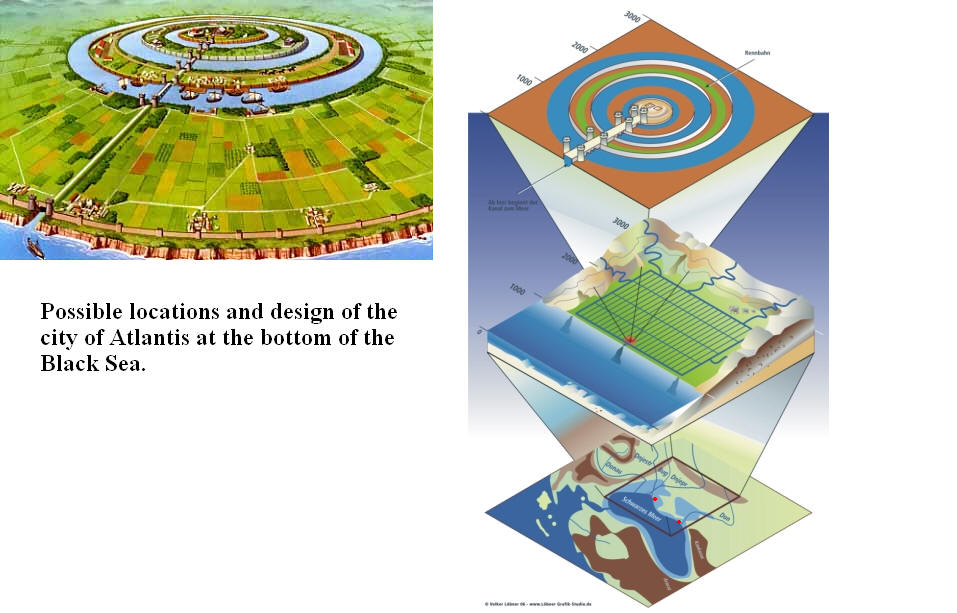
THE DESTRUCTION OF ARYAN ATLANTIS
The Aryans caused their own destruction by allowing other races to misuse Vril
Science. Each individual race must seek their own unique path to obtain control
over the Vril, according to their own unique, individual genetic heritage, based
on the Life Force of the particular pantheon of Gods that gave birth to it. The
employment of the power of the Vril in an unnatural ways led to disastrous
consequences. By trying to educate other races in the use of the Vril, by means
that were natural for the Aryans and other Caucasians, but unnatural for other
races, they contributed to the distortion of the forces of growth and evolution.
This upset the natural relationship between mortals and the pantheon of Gods
that gave birth to each individual race. Each race needs to discover the power
of the Vril in their own way, by traveling their own path to their individual
pantheon of Gods that gave birth to them and contributed to the make up of their
unique genetic characteristics. Each race of humanity has the ability to tap
into the power of the Vril, but because their genetic composition differs, the
process is different for each race. It is dangerous and counter-productive of
one race to try to travel the same path to the Gods as that of another race.
One particular race known to us through historical records as the Turanians,
employed the Vril for their own purposes. But because their racial soul (rooted
in their DNA), was alien to the process they were taught by the Aryans to
harness its power, they could only tap into the destructive side of this force,
and thus, without realizing it, they served the destructive forces of the
Giants. It was this abuse of the Vril science that unleashed horrific and
ominous forces that led to terrible disruptions in the world climate. These
destructive forces upset the natural order of the world climate, thus causing
chaotic transformations that had catastrophic results on the environment of the
world in the sixth century B.C., resulting in the flooding of the Black Sea and
the destruction of the Aryans’ civilization.
Even the training and discipline in the use of the Vril by the Aryans, was not
sufficient to prevent their destruction once they started down the path of
cultural and spiritual nihilism. Once the Aryan civilization was destroyed, the
memory of the great civilization that once spanned the shores of the ancient
Black Sea, gave rise to the many different legends of Thule. Because of the ice
age conditions that existed when the Atlantean Aryan civilization existed,
people eventually thought it had existed near the North Pole. Many other legends
of a golden age civilization was seeded into future civilizations and cultures
as the survivors of the destruction spread across the Eurasian continent.
THE GREAT BLACK SEA FLOOD
One hundred and twenty thousand years ago, the sea level was about where it is
today, but things were about the change radically. During the next 100,000
years, the climate of the planet cooled rapidly. Large regions of the world’s
oceans became frozen and entrapped in great ice sheets that were formed when
water evaporated, and fell as snow, in the Arctic region. The ice sheets grew
into monestrous glaciers, in some place up to two miles thick, as if great Ymir
reached out his hand to claim the world as his domain. By twenty thousand years
ago, so much of the world’s water was trapped in these sheets of ice that the
water levels had declined tremendously. The sea level was about several hundred
feet lower than it is today. Ymir’s ice covered large regions of North America,
Europe, Russia, Asia and South America. Most of the mountains of the world were
covered in the ice. This was the Age of the Frost Giants.
Modern man was around to witness the Age of the Frost Giants. Having emerged
from Africa more than 100,000 years ago, the human race spread out across
Eurasia and soon evolved into both the White and Yellow races. Our ancestors
appeared in Europe about 35,000 years ago. Their appearance displaced the
Neanderthals that inhabited the region. Within a very short period of time they
became extinct before the advance of modern man. Our ancestors possessed
remarkable powers, permitting them to adapt and adjust to the climate they found
in this region of the world. They possessed, a unique ability to understand
their surroundings and invent new technology that permitted them to survive in
the new environment. Their ability to make innovations served them well, and
they quickly learned new skills necessary to survive in this brutal environment.
Eventually, Ymir’s grip on the world began to weaken, as the ice sheets began
meting about 20,000 years ago. As the glacial meltdown intensified, frigid
waters filled rivers that flooded the lands and emptied into lakes, seas and the
ocean, causing the water levels of the world to gradually rise. In northern
Russia and Siberia, huge lakes, like those that exist in North America, were
formed by the melting ice. These lakes no longer exist because the waters that
poured south across the great steppes of Russia and Central Asia, feeding lakes
further to the south, eventually dried up. This process began around 12,500
B.C., and spiked about 9,400 B.C. and created many great fresh water lakes in
central Eurasia. Across Russia, the icy melt continued to flow down rivers into
what is then fresh water Black Sea, the Caspian Sea and the Aral Sea. Both the
Caspian and Aral seas were much larger than they are today, but the Black was
actually much smaller, and its water level much lower. Between 10,000 and 5,600
B.C., the sea level of the Black Sea was about 350 feet below where it is today,
and the rest of the world’s ocean level was about 50 feet below its present
levels. The ocean’s waters were prevented from flooding into the Black Sea by a
natural dam that was formed by a land bridge that existed where the Straits of
the Dardanelles and the Bosporus presently exist, isolating the Black Sea from
the Mediterranean Sea and the oceans beyond.
Our ancestors found the coastal regions around this ancient Black Sea to be rich
with black earth that could produce lust vegetation. They quickly settled down
and developed farming communities that eventually grew into an advanced
civilization. Today, the Black Sea is really a huge lake surrounded by land,
with its only outlet through the Bosporus and Dardanelles to the Mediterranean
Sea. It is more than six thousand feet deep and fed by numerous rivers including
the Danube, the Don and Dnieper. More fresh water runs into the sea from the
rivers and rainfall that is lost through evaporation, but the excessive
freshwater are lost through the runoff to the Mediterranean Sea. But thousands
of years ago, the sea was a very different type of body of water.
In Roman and Greek times, the Black Sea was known as the Euxine Sea because of
the deposits of light gray clay. In 12,500 B.C., the sea was a much smaller lake
than it is now, and was fed by runoff water from the great ice sheet that
covered northern Europe and Russia. The climate began to grow warmer and the
amount of fresh water flowing into the lake was enormous. There were once many
great lakes in northern Russia that no longer exist. Combined with the Caspian
and Aral Seas, which were much larger than they are today, there was five times
as much water trapped in them than there was in the Black Sea. Eventually, the
lakes grew larger until they could no longer contain the water that was stored
within them, and one by one, their crest burst through the natural land damns
that contained them. Their freed discharge flowed down rivers, filling the Black
Sea.
The climate once again grew cold and by 9,400 B.C., and the melting waters of
the ice caps had changed direction, flowing westward across Poland and Germany
to what is now the North Sea. The Black Sea once again shrank until, around
5,600 B.C., it reached its smallest size. The Black Sea could not longer
discharge its waters through the Bosporus. By 5,600 B.C., its surface level was
about 350 feet below the Bosporus dam. At this time, the sea level of global
ocean had risen, and was about 50 feet below its present level.
In 5,600 B.C., the waters from the Mediterranean Sea burst through into the
Black Sea with such force that the land bridge across the Bosporus, which had
served as a natural dam, collapsed, making it impossible for anyone to cross
from Europe and Asia Minor for many years. Since the Caucasus Mountains at the
eastern end of the lake, were covered with huge glaciers, it would have been
almost impossible for people to move south when the Black Sea finally flooded.
Those living on the northern coast, where most of the people lived, would have
fled north and west, while those living on the southern coast, which was small,
would have fled south into the Middle East and Egypt. Few would have fled east
for a while because of the huge barrier formed by the much larger Caspian Sea,
but in time, many refugees would make their way east into Central Asia and
points east and south. But in the west, many traveled along the natural arteries
formed by the Danube, Dniester, Dnieper and Don Rivers. They traveled into the
rich landscapes of Russia and Europe, discovering that the inhabitants already
living there were racially related to them. They would have appeared like Gods,
or God-men because of their superior physical, mental and psychic abilities, but
in appearance, the European would have realized that they were related to them
in some way.
These refugees probably lost most of their possessions, being forced to flee
their homes rather suddenly. Several great migration routes have been discovered
by modern paleontologists and archeologists. One migration route was taken by a
group of tribes known as the Linear Pottery Farmers. They traveled along the
Dnieper River, north of the Carpathian Mountains, through Bohemia and southern
Germany into France. Recent discoveries have shown that their movement was more
like an invasion that swept across northern Europe. Another group of refugees
has come to be known as the Vincas. They traveled up the Danube and into
Hungary. Still another group, much smaller, settled in what is now Bulgaria and
is known as the Hamangians. This group of refugees seemed to be the only group
willing to settle along the new coast live. Others probably feared that there
might be a repetition of the great flood and moved deeper inland. Still another
group eventually crossed the Bosporus and traveled by sea through the Aegean Sea
and into the Adriatic Sea, his migration became known as the Danilo-Hvar
migration. All these refuges brought with them the knowledge of the Vril, but
were unable to reconstruct their lost civilization. Their appearance helped to
spur a cultural and civilizational revolution in technology among the people
they settled among.
The Aryan refugees possessed a technological understanding superior to those
among whom they settled. Despite being refugees, in many cases they outnumbered
the indigenous European, and with their superior abilities, they soon
overwhelmed them. In many places they displaced them, but in most cases they
intermarried with the native Europeans. Since they were of the same race, though
the Aryans were the product of their eugenics program, the assimilation process
was rapid. Modern paleontologists and archeologists have confirmed, through
their discoveries that these newcomers brought with them new ideas and skills
that raised the level of culture and civilization in Europe to new heights.
Because the newcomers had been engaged in commerce for centuries, their presence
in Europe helped to create a rapid expansion in trade throughout Europe. New
techniques in mining and metal smelting were introduced, which stimulated the
production of all sorts of new goods, including tools, weapons, jewelry and
other items. This new revolution in production generated a wide exchange of
manufactured goods.
The migration of refugees southward was a very different event. Because the
southern coast of the Black Sea was much more mountainous, there had been fewer
settlements by the Atlantean Aryans. Thus, the number of refugees that moved
south was much smaller. The exodus south had to cross the wild mountainous
region of the Anatolian plateau. The region was already populated, and many of
those there probably had contact with the Atlantean Aryans before the terrible
flood. There is evidence that this region experienced an influx of people right
after the flooding of the Black Sea. This was especially true of the Lebanese
coast. In the sixth millennium B.C. there was a massive influx of farming
peoples, who were refugees from the Black Sea flood. Egypt also experienced a
rise in its cultural levels at this time, and its economy expanded during the
period right after the flooding of the Black Sea. Everything from the
introduction of new cereals and domesticated animals to new agricultural methods
and irrigation planing, were introduced during this period.
Transcaucasia, the region between the Black and Caspian Seas, experienced a
sudden appearance of advanced farming technology. As if the knowledge sprain up
out of thin air, the peoples of this region abruptly began constructing
buildings and planning towns surrounded by planted fields and farms.
Archaeologists agree that the transformation was so sudden that it had to be the
result of an invasion of the region by outsiders with superior technology.
Carbon 14 dating has shown that the transformation taking place throughout the
Middle East, in Egypt, and Transcaucasia, all dates from right after the Black
Sea was flooded.
In the ancient land known as Mesopotamia, saddled between the Tigris and
Euphrates Rivers, this hot and arid desert land was the sight of one of the
first civilizations, and perhaps the cradle of the Western and Semitic
civilizations. It was here that the first great cities recorded in history
appeared. Suddenly, as if they sprain out of the desert sands, communities
appeared and very rapidly grew into city-states. The region experienced an
invasion by refugees of the Black Sea flood. Driven out of the mountainous
north, they followed the two great rivers until they could go no farther,
because they had come onto the Gulf of Persia. Here they mixed the local people,
who far outnumbered them, but with their assistance, they began to irrigate the
desert, transforming the hot, burning landscape into lush gardens and fields
rich with green vegetation. They next began to construct great cities. Trade and
commerce soon grew up between the city-states. The newcomers were Atlantean
Aryans and they brought with them what they were able to salvage of the Vril
Science. They used the power of the Vril to transform the deserts into
breadbaskets. The civilization that grew up is known to us as Sumeria, and the
Sumerian people remember the arrival of the Atlantean Aryans out of the north,
in their myths and religions, referring to them as God-men, possessing great
powers and possessing superior knowledge and technology.
The Sumerian language escapes definition, but most linguists agree it is not
native to the region. Generically, the people are similar to the most ancient
and original Egyptians, who were a small, Mediterranean White race. In the
Sumerian Poem of the Supersage, they speak of their own origin beginning with
the arrival of a race of God-men from the north, dating back to a time right
after the great flooding of the Black Sea. In the tale of Gilgamesh there were
seven sages or wise men, appearing from the sea wearing fish skins. They are
credited with the construction of the walls of the city Uruk, and bring
civilization to the Sumerians, which included irrigation, farming, construction,
the use and smelting of metals, and the art of writing. Before their arrival,
for seven millenniums, the native people of this region lived among the foot
hills of the Taurus and Zagros mountains, never venturing down to the desert
banks of the Tigris and Euphrates rivers. It was not until the Atlantean Aryans
arrived did they follow them and did their bidding. Under their leadership, they
built the great city-states.
The colonization of the desert was achieved under the leadership of the God-men
from the north. Only with the new farming and irrigation technologies that they
brought with them, based on Vril Science, could they transform this most harsh
desert region into a garden. Using Vril Science, they were able to master the
waters of the Tigris and Euphrates rivers. They built great estates for
themselves, as well as public temples and walls around their cities. The native
people were not slaves, and they benefitted and grew rich under the rule of
these God-men. The God-men were depicted in Sumerian art as tall and possessing
long, narrow heads with Caucasian or European features.
The Aryans ruled over the more numerous native people, but in time, through
intermarriage, they disappeared into the population. But traces of their
existence were left behind in the Sumerian language. The Sumerian language is
described as monosyllabic. But there are exceptions to this rule. Those words
dealing with agriculture and crafts are not monosyllabic, but actually
polysyllabic and thus foreign. This is especially true for words describing
farmer, herdsmen, shepherds, fishermen, plows, metal smith, blacksmith,
carpenter, weaver, leather-worker, mason, brick-maker, potter, merchant, and
even bankers. These words were not native to the Sumerian language, but were
introduced by the northern invaders–the God-men from the north.
The language or languages of the original Atlantean Aryans are no longer spoken,
but linguists have been able to reconstruct the dead languages, and with the use
of sometime like a tree diagram, they can show how the languages spoken to day
are related to one another. Traces of the language spoken by the ancient
Atlantean Aryans can be found in many of the ancient languages, and in those
languages spoken at the present time in Europe and Asia, in those territories
that the Atlantean Aryans fled to, after the flood.
Genetic studies have also shown the relationship among the present day peoples
of these regions. Genes related to the ancient Atlantean Aryans can be detected
in the populations throughout Europe, the Middle East, India, Central Asia and
North Africa. Those who fled from the flood migrated throughout these regions
and have left their genetic traces, in various degrees, in the gene pools of the
populations in these regions, leaving behind proof of their one-time presence.
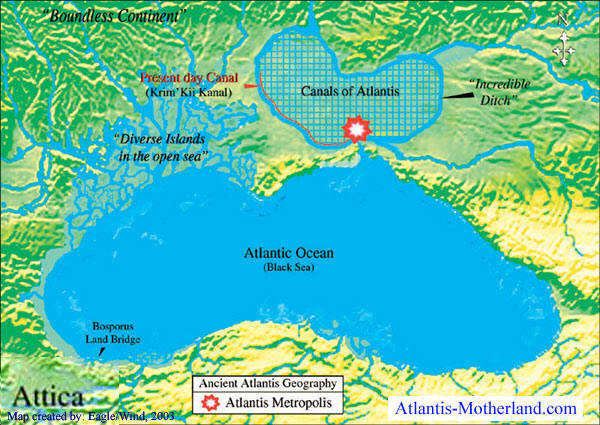
THE INDO-EUROPEANS: THE ATLANTEAN REFUGEES
Genetic evidence has shown that a great wave of people migrated through Europe,
possessing superior technology. As they met people already living in Europe, who
were racially related to themselves, though lacking their superior technology
and genetic modifications, they interbred with one another. Geneticists have
been able to construct a genetic family tree showing the relationship of all
European peoples to each other. Each ethnic group on the branches of the tree,
signifies the magnitude of the genetic variation that developed throughout these
millenniums. Since the branches reflect a genetic drift, the geneticists were
able to trace the ancestry of the Europeans backward to their original primeval
homeland.
The Human Genome Project has shown that modern humans, homo sapiens sapiens,
originated in Africa. About 100,000 years ago the first humans left Africa and
settled in the Middle East. From here, one branch set out east across the Asian
subcontinent and eventually crossed the Indonesian channel and settled in
Australia. Another branch moved into eastern Asia, while still another branch
moved north and eventually crossed the Bering land bridge into North and South
America. But still another branch crossed the Bosporus land bridge into Europe.
As these different branches of the original proto-humans spread out across
Eurasia, different pantheons of Gods then descended to earth and mixed their
Life Forces with different segments of the proto-humans, thus stimulating the
evolutionary process and dividing mankind into the different races of man that
we are familiar with today. All pagan religions, not just the Indo-European
religions, but pagan religions of every race have “origin stories” describing
how their pantheon of Gods once walked the surface of the earth and mixed their
essence with their ancestors, creating their own particular race. In The Secret
Doctrine, Blavatsky explains how the whole evolution of mankind was affected by
the intervention of superior beings—the Gods.
This racial memory is typical of all humans and has survived thousands of years,
untainted or distorted. A good example of this is the Hymns of the Rigveda,
which has been passed down for twenty-five centuries in two versions: one
written and the other oral. Amazingly, both versions have remained consistent
through the centuries, even after the oral version was eventually written down
by monks, who no longer spoke the Sanskrit language in which it was passed down.
The monks who eventually put it to the pen, probably no longer understood most
of what they were writing, but still they kept it unchanged. The reason for the
survival of these myths and legends is simple–they are racial memories that find
nourishment from the well of knowledge, the Mimir Well, that is located deep
within the brain of each person.


Throughout Eurasia there are many myths about superior and fantastic
civilizations now lost in prehistory, and now extinct Golden Ages when humans
lived in a semi-divine state with the Gods, and possessed superior intelligence,
physical powers and psychic abilities. But the memories of these lost
civilizations or civilization–the mother civilization–remains alive within each
of us. And all these tales end in the same way—with a terrible fall of man.
Numerous mythologies and religious traditions speak of a race of men who were
equal to the Gods, or born of the Gods. Most of them include some terrible
natural calamity involving some type of terrible flood or of a land sinking
beneath the sea thousands of years in the past, before recorded history. Those
who survived usually make their way to the great plateaus or mountains of
central Asia, Tibet, Ethiopia, Asia Minor or Iran. Those survivors eventually
spread out across Europe, Asia, the Middle East and North Africa, mixing with
the native peoples already living in these regions. As they did, they brought
with them great knowledge from which they taught the native populations to build
great new civilizations. As a result, the refugees were often looked upon as
Gods, or as a race of God-men.
The refugees soon divided into tribes of different people, speaking languages
descended from the original language that they once spoke in their original
homeland along the shores of the Black Sea. They were the Aryans, and referred
to as Atlanteans by later scholars. They possessed the secrets of the Vril
Science, and though most took only part of this lost science with them, it was
enough to make them appear as if they possessed supernatural powers. These
Indo-Europeans migrated east into China and India, south into Iran, Sumeria and
Egypt, west into Europe and the Mediterranean, and even settled on the Canary
islands in the Atlantic Ocean. In all cases, they mixed with the native people
they found living in these regions. In those regions where the natives were of
an alien race, such as in India, the Middle East or Egypt, they set themselves
up as a ruling class, separate and distinct from those they ruled. But in time
they assimilated and disappeared into the mixture. In other places, where there
were no native populations, such as Sinkiang (Xinjiang), in western China, they
created a new and superior civilization that lasted thousands of years in their
isolation. In places like Europe, where the native population was of the same
race as the Indo-Europeans, but in a pre-Vril state, they quickly assimilated
into the population, losing their superior powers.
Plato claims that another Greek by the name of Solon, transmitted to him
information about Atlantis. He also claimed that Solon learned of Atlantis
directly from the Egyptians. They explained to Solon that the descendants of the
Atlanteans, who settled in Egypt, told the Egyptians how their original homeland
was destroyed in a great flood. They were among the many Indo-Europeans who
moved south into the Middle East, settling in Sumeria, Palestine and eventually
making their way into Egypt. They brought with them bits and pieces of their
Vril Science. They set themselves up as God-men and rulers over the Semitic,
Hamitic and other peoples that lived in these regions. In Egypt, they were
worshiped as the “Sons of the Gods,” and ruled over Egypt as pharaohs. These
pharaohs used the anti-gravity powers of the Vril to move the great stones over
hundreds of miles and set them in place in the construction of the great
pyramids, cities and other monuments.
The Egyptians believed that these God-men were descended from a land they called
Pount, and it was located far away from Egypt. The Egyptians venerated this
distant land that they claimed sank beneath the sea. According to Egyptian
beliefs, two of the members of ths race of Egyptian Gods or God-men, Min and
Hothor, were said to have journeyed to Egypt from this Divine Land, and that
they instructed them in the use of Vril Science. They were distinctively
different in appearance to the smaller, copper-flesh colored Egyptians, who were
primarily Caucasian-Mediterranean types. The God-men were tall, almost giantlike.
Their eyes sparkled with the color of the sea and their hair shined yellow, like
the sun. They were fair and beautiful to look upon and they set themselves up as
an aristocracy among the Egyptians. But in time, they mixed with the native
population and eventually degenerated, losing their genetically enhanced powers.
As they continued to intermarry with the native population, the genetic
mutations that gave them their great powers disappeared, and by the Eighteenth
Dynasty, these God-men had disappeared completely into the gene pool of the
native Egyptians.
When the Spaniards first discovered and explored the chain of islands off the
northwest coast of Africa known as the Canary Islands in 1409, they found an
unspoiled race of beautiful people living there. The natives of the Canaries
claimed they were the direct and unpolluted descendants of Atlantis. Their
height was imposing, averaging seven feet tall, which is similar to mummies
found on the islands, as well as in northwestern China. They had a cranial
capacity of 1,900 cubic centimeters, the largest known brain size ever recorded
among humans anywhere. The cephalic index of the male skulls was 77.77. They had
blond hairs, as did the mummies, which are thousands of years old.
The refugees of the Black Sea flood split into two groups. The first were the
majority and had lived on the northern, eastern and western coasts of the Black
sea. The remainder had lived along the narrow southern coast. When the Black Sea
was flooded, the two groups were separated because the collapse of the Bosporus
land bridge in the west and the natural barrier that the glacier-covered
Caucasian Mountains formed in the east. Thus, the southern group of survivors
fled south into Asia Minor, the Middle East and eventually North Africa, mixing
with the peoples they found there. Many of the people living in Asia Minor had
been influenced by the Aryans long before the flood. As far back as 7,000 B.C.,
people living there had been smelting copper into hooks, pins, knives and other
tools and instruments. Those remained there after the flood, and eventually
become the Indo-European nations of Anatolian Group: the Hittites, Phrygians and
Lydians. Others would continue their journey south into Mesopotamia, Palestine
and eventually into Egypt. Their numbers were small and though they introduced
civilization to these lands, their language never replaced those spoken by the
local people.
While the original Aryan language survived for a time in Asia Minor, evolving
into the speakers of the Anatolian group, the northern group eventually broke up
into several additional groups. One of them moved west, into the interior of
Europe and evolving into the speakers of Germanic, Celtic and Italic languages.
Another group traveled into the Mediterranean, evolving into the speakers of
Greek, Thracian and Illyrian. Other groups ventured east across the northern
coast of the Caspian Sea and into Central Asia. This last group also broke up
into several groups. One branch settles along the shores of a lake that once
existed in the Tarim Basin, in western China, and there founded what is known as
the Torcharian civilization. The rest of this group moved southeast into Iran,
Afghanistan and India. These were the speakers of the Iranian and Vedic
languages. According the both linguistic and genetic researchers, the divisions
took place in the early fifth millennium B.C., about six hundred years after the
flooding of the Black Sea.
As early as the eighteen century, Sir William Jones in India, who was interested
in philology, noticed the similarities of Sanskrit and European languages. Soon
a new discipline rose up studying what became known as the family of
Indo-European languages. Philologists began speculating about the original
language of the Indo-Europeans and the location of its original homeland. They
referred to this language as the Ur-language, and the people who spoke it as the
Ur-people, and their original homeland as the Ur-homeland. “Ur” stood for
“proto” or “original.”
In Europe, the Indo-Europeans spread across the continent in several waves,
mixing with those Caucasians already living there. Genetic evidence reveals only
about 20 percent of the DNA of modern Europeans is actually descended from the
invading Indo-Europeans. This proves that the Indo-European tribes that spread
across Europe settled among the non-Indo-Europeans, ruling over them, and
eventually assimilating with them. In most cases they were a minority, but
because of their superior abilities and science, they quickly became the ruling
aristocracy. In time, most Europeans adopted their language, religion and
customs, though much of the original European culture survived, mostly
assimilated into the newer Indo-European culture, but in some cases, as with the
Basques, the original culture and language survived in a much purer form.
The first wave of Indo-Europeans began in the fourth millennium B.C. The culture
and civilization that rose up in Europe left evidence of its existence in the
many megalith structures scattered across Europe. These monuments, belonging to
this first great civilization in Europe, can be found as far south as the
islands of Malta and Sicily, to Spain in the west, to the British Islands, and
Scandinavia in the north. It was incorrectly thought at one time that they were
evidence of explorers from the Mediterranean—the Phoenicians, the Egyptians or
Cretan—sailing through the Straits of Gibraltar and settling along the coast of
southern, western and northern Europe. But carbon dating has revealed that these
megalithic monuments and structures were built long before these peoples had
developed sea travel. But even as late as the first millennium B.C., none of the
Mediterranean civilizations ever developed a ship that could sail successfully
in the rough waters of the northern Atlantic. But we do have evidence that
Europeans once possessed such a ship. Rock-paintings found in Bohuslan, in
southern Sweden, dating as far back as 1800 B.C., show a long, low, streamlined
ship that looks remarkably like a primitive Viking ship that would be seaworthy
in the northern Atlantic waters. The Phoenicians did not develop such a ship
until around 1100 B.C.
Most of the megalith structures predate the Phoenicians by thousands of years.
We now know that the 1,168 menhirs which stand in endless roles at Menec near
the Bretan resort of Carnac, were erected around 3500 and 2500 B.C. In Ireland,
the oldest stone structure in the world, Newgrange, dates back to around 3500
B.C., and work on Stonehenge began before 1400 B.C.
From the evidence emerging, we now have a new image of prehistoric western
Europe, not as a dark, primitive and barbaric region, existing in the shadow of
the more civilized Middle East, but of an advanced civilization, utilizing bits
and pieces of a lost science—Vril Science—to construct great stone structures
and living in communities close to Nature, building dolmens, erecting menhirs,
constructing stone tombs, stone houses and villages, and studying the motion of
the sun, the moon and the stars. The climate around 5000 B.C. was warmer than it
2000 B.C.. Vines grew as far north as southern Norway and deciduous forests
covered most of Scandinavia.
The survivors of the lost civilization of Atlantis, which existed not in the
Atlantic Ocean, but on the shores of the ancient Black Sea, built two very
different types of civilizations. In the Middle East, India and North Africa,
where they were a tiny minority among alien races, and where the land was often
arid and dry, they ruled over the majority of people and eventually disappeared
through intermarriage. The civilizations they founded, were highly urbanized
because of the shortage of fertile land. But in the more fertile and lust
landscapes of Europe, they found people who were racially the same as they were
and an environment that could support large agrarian communities. The
civilization they built in Europe was more agricultural and existed in greater
harmony with its natural surroundings. They quickly assimilated with the people
there, becoming one race, which adopted their customs, language and religion.
Thus, after 5000 B.C., there were at least two poles of civilization—one in
western Europe and another in the Middle East.